Priority Management for an enterprise data centre
One portal in which operators and customers kept continuous sight of the quality and availability of the services delivered.
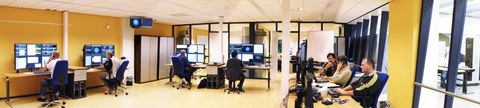
For a large national data centre — with customers such as ProRail, ABN AMRO, Albert Heijn and Fortis — we built PriMa. The portal ran day and night, operated by a crew of three to six operators. The way of working it embodied only got a name years later: DevOps.
From a stream of alerts to priority
Major customers expected continuous insight into the quality and availability of their services. The monitoring tools delivered an unbroken stream of raw alerts for that — but no answer to the only question that counts on the floor: what needs to happen now, and by whom? PriMa was the layer that provided that answer.
How do you steer a crew that never speaks to each other?
Operators worked a continuous rota. What one shift agreed or observed, the next shift had to find without a handover conversation. And the raw stream of alerts from the monitoring tools said nothing in itself about what needed to happen now. PriMa translated that stream into priority, ownership and follow-up.
What we built
PriMa consisted of a number of interrelated components, from scheduling manual work to a rule engine that turned monitoring data into actionable information.
Capturing and scheduling recurring work
- Define recurring checks and schedule them per customer and per system, down to the quarter-hour: a check that must be completed every morning between 10:00 and 10:15 appears as such in the schedule.
- With 'Focus', an employee indicates which OPS role they fulfil this shift. From then on the entire system shows only information about the customers and systems belonging to that role.
- The 'Logbook' records agreements and completed actions, linked to the relevant customer, system or incident. The next shift sees immediately where an issue stands.
Who sees what, and who gets called
- Personal and group profiles determine who receives which steering information: which focus, at what moment, with which action.
- The standby planner records who is available outside office hours, per role and per period.
- Escalation is part of the model: when an alert is left unattended, it demonstrably moves up to a higher corporate level.
A generic rule engine for activities
- An activity is an event that requires action. Rules filter, enrich and transform those activities into concrete actions or projections.
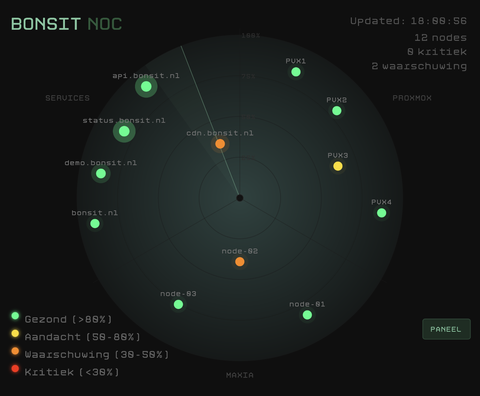
- That is how the unstructured stream from the monitoring tools was turned into data you can actually show on a radar.
- Because the logic lived in rules rather than in code per tool, the system could keep pace with new sources and changing agreements.
Seeing at a glance where you stand
- PriMa's ops dashboard, which took many forms over the years and was refined further and further — from heatmap to radar.
- The aim was always the same: giving operators and customers almost tangible feedback on the state of the data centre and the services delivered.
- Steering purposefully instead of reacting to whichever alert happens to beep loudest.
What it did to the organisation
The most interesting effect was not in the technology but in behaviour. Reactions from the organisation at the time, on the effect of the Activity Radar:
“Seeing at a glance where you stand.”
“I have far less to remember; my head is nice and calm.”
“Denial is no longer an option; you have to do something about it.”
“I’m much more productive now, and less stressed.”
“We talk about priority far more often, instead of about time.”
“Our existing processes and tools could simply stay intact.”
“At last there is alignment between tools and processes; mismatches are spotted and corrected quickly.”
What proved itself here is now part of the foundation
PriMa was already solving problems that organisations still wrestle with today: roles and focus as first-order concepts, every action recorded and traceable, escalation built into the model rather than agreed on a sheet of paper, and a dashboard that does not merely display but prompts action. Those principles have proven themselves in practice and have grown with us. What took years of design work here is now the starting position of every platform we build.